
This Is How To Handle Your Short Term Crypto Gains Tax Without Losing Sleep
Short Term Crypto Gains Tax: Made Simple (Yes, Really)
Look, your short term crypto gains tax doesn't have to be a headache. I've been poking at the IRS rules and the plain fact is this: if you sell, trade, or spend crypto you held a year or less, the gain is taxed like normal income. That's the whole short version right there. The short description says it best - here's what you'll owe on crypto held a year or less, and how to report it without summoning the IRS.
The IRS treats crypto as property, not money. So when you get rid of it - sell for cash, swap for another coin, buy a pizza with it - that's a taxable event. Your gain is what you got minus what you paid (fees included). I care about this stuff because a lot of folks I know got spooked by letters from the IRS and had no clue they owed on a simple trade.

How The IRS Sees Crypto
The IRS calls crypto property. That means every time you dispose of it, you might owe tax. A taxable event is when you sell, trade, spend, or earn crypto. Buying with cash, moving between your own wallets, and just holding - that's not taxable. The form 1040 asks about virtual currency and you gotta answer it under penalty of perjury. Don't skip that part.
Around 55 million Americans own crypto now. The IRS made digital assets a top enforcement priority, so they're watching. If you earn crypto from staking, mining, airdrops, or pay for work, that's ordinary income the day you get it. I think that surprises a lot of new buyers who just thought "nothing happens till I sell."
Receiving crypto as payment for work is also ordinary income.
What Counts As Short Term
Short-term capital gains are on crypto held one year or less before you dispose of it. Some say 365 days or fewer, others say "one year or less." Either way, if you sell, trade, or spend crypto inside that window, the gain is taxed as ordinary income at your regular federal income tax bracket. It's the same as wages.
This is where the short term crypto gains tax bites. A trade from BTC to ETH counts. Spending coins at a store counts. Even a DeFi swap counts. The clock starts the day after you buy, so track your dates like a hawk.
Things that trigger short term tax
- Sell crypto for fiat cash
- Trade one coin for another coin
- Spend crypto on goods or services
- Earn crypto from staking, mining, airdrops
Short Term Vs Long Term Rates
For crypto held a year or less, you pay ordinary income tax. That ranges from low to high rates based on your bracket. For crypto held more than one year, the rate is lower - often 0%, 15%, or 20%. The tax code rewards waiting. I like that part, it's like the only patience prize the IRS gives.
Higher-income folks may owe an extra 3.8% net investment income tax. Some NFTs are treated as collectibles with a max 28% long-term rate. But for the short term crypto gains tax, none of that fancy stuff - you just pay your normal rate like a paycheck.
Long-term capital gains apply to crypto held more than one year.
Figuring Out Your Gain
The math is simple: proceeds minus cost basis. Proceeds is what you got (minus fees). Cost basis is what you paid plus fees. Example from the source: buy BTC for $1,000, sell for $1,500, gain is $500. With fees: buy $300 BTC pay $10 fee, basis $310; sell for $400, gain $90.
If you don't know your cost basis, try to rebuild it from bank statements and chain history. If you can't, the IRS says treat the whole proceeds as gain. For multiple buys, you can use FIFO, LIFO, HIFO, or pick specific lots. Since Jan 1 2025, FIFO is default unless you pick another method first, and you must track per wallet.
Ways to track lots
- FIFO - first in, first out (default now)
- LIFO - last in, first out
- HIFO - highest in, first out
- Specific ID - pick the exact coins sold
Reporting Your Short Term Crypto Gains
Capital gains go on Form 8949 and sum up on Schedule D. You list every trade: date bought, date sold, proceeds, basis, gain or loss. Crypto income like staking goes on Schedule 1 as other income, or Schedule C if it's a business. Form 1099-DA is info only - you still file 8949 with your own basis.
The IRS matches data from brokers now, so mismatches get auto letters. I'd say don't wait for the letter to care. If you use a coinbase wallet tax documents from your exchange, check it against your own notes before you file.
Crypto Income Taxed Like Short Term
Short-term gains and ordinary crypto income both get taxed at ordinary rates. Staking rewards are income at fair value when received. Mining is ordinary income, or self-employment if it's a business. Airdrops, hard forks, DeFi yield - all ordinary income when you get them. If you later sell, you owe a gain on the bump from that value.
This matters because people think only selling is taxable. Nope. Got an airdrop worth $200, that's $200 income. Sell it later at $250, that's $50 gain on top. The irs cryptocurrency reporting rules want both chunks shown.
Ordinary income crypto events
- Staking rewards when received
- Mining as hobby or business
- Airdrops at fair market value
- Hard fork new tokens
- DeFi interest and yield
- Payment for goods or services
Specific Trades And What They Mean
Crypto-to-crypto trade is a taxable disposal. Example: trade BTC for ETH, gain is value of ETH minus basis of BTC. Spending crypto is a disposal too - gain is value of stuff minus basis. DeFi swaps on a DEX are taxable. Providing liquidity and getting LP tokens is often a taxable swap.
NFTs you buy with crypto is a disposal. Selling an NFT is a gain or loss. Gifts under the annual exclusion are fine. Donations to charity avoid capital gains. Stablecoins are taxed same as crypto, but gain is near zero. Wash sale rule doesn't apply to crypto yet, so you can sell at a loss and rebuy - but that may change.
Wrapped tokens: unclear, conservative treat as taxable exchange.
New IRS Reporting Rules
Brokers must send Form 1099-DA for digital sales. For the first year, cost basis not required, but later it is. The IRS matches the data, and if it doesn't line up, you get a letter. Per-wallet basis tracking is now mandatory. Universal tracking across wallets is gone.
Some things are exempt from broker reporting - wrapping, LP tokens, staking - but they're still taxable. If you run a corporate crypto account or a cryptocurrency fund , the same basis rules hit you, just at fund scale.
State Taxes On Short Term Gains
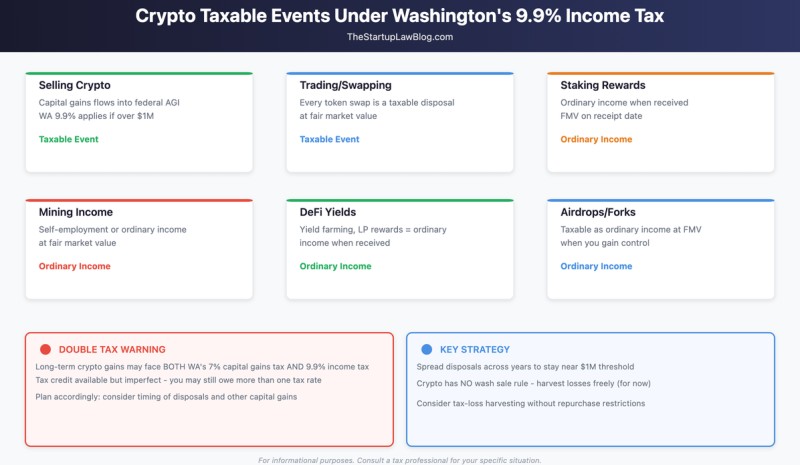
Most states tax short term gains as ordinary income. Washington State has a 9.9% tax on federal AGI above a high threshold. Your short term crypto gains and ordinary crypto income flow into federal AGI, so they count. Long-term gains there have a separate tax, with a credit to avoid double tax.
Planning ideas: spread sales across years, harvest losses, time staking, track basis well. If you use fidelity and crypto or similar big broker tools, pull the state view before you file so you don't get surprised.
Ways To Lower The Tax
The easy one: hold over one year for lower long-term rates. Tax-loss harvesting lets losses offset gains and some ordinary income, carried forward. IRA holds are tax-deferred. Donate crypto to dodge gains. Use tax-advantaged accounts. Time sales for low-income years.
Spread disposals to avoid state lines. Keep clean docs. Pick your lots with care. If you use a crypto tax calculator software or crypto software for taxes , it can map these moves for you so you don't miss a beat.
Common tax-saving moves
- Hold past one year for long-term rate
- Harvest losses to offset gains
- Use an IRA or 401k for crypto
- Donate crypto to charity
- Sell in a lower-income year
Easy Mistakes People Make
Not reporting crypto-to-crypto trades is a big one. Ignoring staking or airdrop income when received. Bad record keeping with the wallet rule. Wrong basis from skipping fees. Not tracking hold time. Underpayment from big mid-year gains.
The era of casual crypto reporting is over. If you use taxes for crypto com type apps or exchanges, still check the numbers yourself. The IRS sent warning letters in the past and can fine or worse for fraud. Hey, don't skip this part - matching matters now.
Penalties for intentional tax fraud: fine up to $250,000 and 5 years prison.
Examples From Real Cases
Sean buys $3,000 BTC, sells $3,300 - $300 short-term gain. Jordan buys $1,000 BTC, sells $1,500 - $500 gain. Jamie trades $1,000 BTC for ETH at $1,200 - $200 gain. Rachel buys $2,000 SOL, sells $1,500 - $500 loss to offset others.
Sara earns $200 ETH staking, sells at $250 - $200 income plus $50 gain. Megan gets 2.5 Bitcoin Cash from a fork worth $1,250 - that's $1,250 income. Billy buys $10k on Exchange A, moves to cold wallet, sells $15k on B - B lacks basis, so he must self-report. That last one is why your own notes matter.
Sample gains and losses
- Sean: $300 gain on $3,000 BTC
- Jordan: $500 gain on $1,000 BTC
- Jamie: $200 gain from BTC to ETH
- Rachel: $500 loss on SOL to offset
- Sara: $200 income plus $50 gain
What The Tax Bracket Looks Like
Your short term crypto gains tax is just your income tax. The rate goes up as your income goes up through brackets. The exact cutoffs shift each year, but the idea is steady: more gain, higher bracket, more tax. The tax bracket for crypto is the same bracket as your job pay.
If you also trade foreign coins, the rules get odd. I won't dig into how to invest in yuan cryptocurrency here - that's a whole other post - but know the IRS still wants the gain reported in dollars.
Keeping Good Records
All sources say keep detailed records across wallets and exchanges. Use crypto tax software if you trade a lot. A CPA helps with DeFi, DAOs, or big portfolios. The wallet-by-wallet rule means you can't mix bases anymore.
I'd start a simple sheet the day you buy. Date, amount, price, fees, wallet. Then when you sell, the gain is right there. It's boring but it beats a letter from the IRS. And yeah, the short term crypto gains tax is simpler when your notes are clean.

Why This Matters For Normal People
Most crypto holders are not accountants. But the IRS sees every 1099-DA now. If you traded inside a year, that gain is income. The short term crypto gains tax is not a mystery - it's just your normal rate on a short hold.
Take a breath. Report the trades, show the income, track the dates. You don't need to be a pro, you need to be honest and organized. The source says it plain: crypto is property, and short-term gains on crypto held a year or less are taxed exactly like normal income.
The IRS treats cryptocurrency as property, and short-term gains on crypto held a year or less are taxed exactly like normal income.



Comments on “This Is How To Handle Your Short Term Crypto Gains Tax Without Losing Sleep”
No comments yet. Be the first to share your thoughts.